Wednesday, December 1, 2021

DOST sets up ‘SET-UP’ 
online orient on Dec 1

CORTES, Bohol, Nov 27 (PIA) –Are you a registered micro, small, and medium enterprises (MSMEs) in Bohol and dreams of a production upgrade but is short in needed capital?

Chances are, the Department of Science and Technology (DOST) can help.

By waving Small Enterprise Technology Upgrading Program (SET-UP) the DOST banners a nationwide strategy to encourage and assist MSMEs to adopt technological innovations to improve their products, services, operations and increase their productivity and competitiveness.

The DOST help would focus on enabling MSMEs to address their technical problems and improve productivity and efficiency through the Infusion of appropriate technologies to improve products, services and/or operations.

It also helps MSMES in human resource training, technical assistance and consultancy services, design of functional packages and labels, assist in the attainment of product standards including testing, database management system and the provision of assistance for technology acquisition.

For Bohol, the DOST is into helping entrepreneurs in the food industry, including water refilling business, furniture, Gifts and Housewares, decors, marine and aquatic resources as well as horticulture and agriculture.

The DOST is also into helping small investors in the metals, engineering and fabrication, those into health products and services including pharmaceuticals.

The Science agency is also helping small investors in the Information Communication and Technology and Electronics like software and web and web applications including applications development.

For these enterprises, the DOST can offer upgrading of production equipment, tecgnology needs assessment, product development and Value Chain Development.

Moreover, The DoST can venture into consultancy services, laboratory services, product packaging and labelling, innovations like putting up the enabling fund for rent to own schemes.

To get to know how the DOsT can help your small business, join the SET-UP Online Orientation on December 1 at 10:00 in Facebook Live or on Zoom. .

To keep track of the orientation participants, the DOST need a pre-registration, which can be accessed through google documents, that they ask interested entrepreneurs to register in advance for assured slots.

nationwide strategy encouraging and assisting micro, small, and medium enterprises (MSMEs) to adopt technological innovations to improve their products, services, operations and increase their productivity and competitiveness.

For those wanting to pre register, click on https://forms.gle/DHJRkQUunt83cA7o8 and fill the forms to be assured of a slot, or visit the DOST Bohol PSTC on face book, to get the link. (rahc/PIA-7/Bohol)
DTI surpasses ‘Craft Fair’ 
Targets: exhibitors, sales

TAGBILARAN CITY, Bohol, Nov 27 (PIA) – The Department of Trade and Industry in Bohol breached its P700K sales target, surpassed expectation with 55 exhibitors from 30 micro, small and medium enterprises joining the third blended “Holiday Market and Crafts Fair, which ran at the Activity Center of the Island City mall from November 21-27, 2021.

The 55 exhibitors from 21 local government units brought in Christmas decors, gifts and housewares, fashion accessories and processed food to the 6-day Fair which tried to build on the successes of two previous blended pop-up exhibits.

This year, DTI Bohol put up Mugna’ng Bol-anon PopUp Exhibit in July and Bamboo PopUp Exhibit in September, both on blended trade shows which yielded positive results and feedbacks, not only from consumers but also from the exhibitors.

This has prompted the DTI Bohol to mount another trade show in November, dubbed as “Holiday Market and Craft Fair,” where DTI can help its assisted micro, small and medium enterprises (MSMEs) rebound and recover from the impact of COVID 19 on their operations.

The DTI sees that micro, small, and medium enterprises (MSMEs) need all the support they can get to bring their operations close to normal, and make more meaningful sales which they hope to generate through virtual marketplaces, physical trade shows and bazaars, and many others, said DTI Bohol Director Maria Soledad Balistoy.

The forefront of the holiday market was the conduct of product development for participating Bohol MSMEs. The product development program started in September and the final prototypes were be collected for the exhibits, added DTI SME development Division chief Vierna Teresa Ligan.

The fair, also called by many as Christmas in November intends to strengthen MSME support by allowing businesses to showcase their goods, disperse knowledge and establish business linkages with customers and the market and offers them the opportunity to get on a new customer’s radar as a product or company that they need to establish linkage with.

While doing this, we are able to offer MSMEs venue to market to customers and then sell their products, while we at DTIO, could mount the six-day November Bazaar, Ligan continued.

Done with strict observance of health and safety protocols, the fair initially targeted 30 exhibitors from all DTI assisted MSMEs through its Shared Service Facility Program, Comprehensive Agrarian Reform Support, SME Roving Academy and Negosyo Centers projects.

The turnout however came more than expected as 55 exhibitors showed up on ingress to egress, fair organizers said.

As to sales, from P700,000 initial target as proposed, the fair has already posted P1.1 million in booked and physical sales as of the closing of the sales books on Day 4. (rahc/PIA-7/Bohol)

Feature:
Sinapido: handwovens
all in MaraAram’s bag

It was an early exposure to bag-making and design that fairly made his life all in a bag.

Lauro Lopido, at 41 now, was a step away from reverting to his supervisory job in a small bag production company in Saudi Arabia, but he persisted and somehow, things paid off.

He was a fresh high school graduate from Dolores Eastern Samar when he went to Manila to try his luck and got into a job in a bag factory.

His task then was inverting bags, so the sewers could put in some needed parts. On his spare time, he would sit in the factory’s sewing assembly line and try his skill at bag-making, knowing that it could be a better money source than a factory handyman.

Persistence, patience and perseverance plus his newfound profitable skill brought him to try it out in the Middle East and in Brunei where he met his soon to be wife, Marlyn Anabieza of Santo Rosario Inabanga.

After his marriage, the couple decided to live in Bohol and put his skill in line.

“I was fixing school bags in the neighborhood, and it was really not much considering I was new and there were not many to fix,” Lau shared in an interview.

That time, he was about to give up, go back as an overseas worker to feed and sustain his family.

But then, when who brother who works with the government in Samar told him to seek assistance from the Department of Trade and Industry (DTI) in Bohol, an option opened for him.

“I went to DTI and asked what they can do. Form then, things started to work out right,” he said.

Settling in town with a long string of raffia loom-weaving tradition, the trainings in product design and innovation started for his bag business the new he has since followed.

We found sinalapid, a raffia pigtail weave that we overlaid in the design and played on contrasts and things soon picked, he said, his being Waray-speaking showing.

Sinalapid or sinapid weavers in Bohol, found a good market as Lopido’s hand crafted bags soon got them as a trademark.

“That was also the start of the brand name Sinapido,” he said.

Later design innovations had Lopido venturing into more raw materials, several of them locally woven and sourced out from other weavers in Bohol who specialize in other designs and materials.

From sinapid, Lopido’s bags now feature buntal, synthetic fibers, threads, up-cycling materials, recycled objects and just anything that could be a highlight, motif or simply an interesting contrast that makes the bag chic, stylish and fashionable.

Already making big ripples in the handcrafted bag industry in Bohol and in the country, MaraArams Baglines became a must have among people in the high society.

And then the pandemic struck.

We have to divert our bag production as there were no sales, and we have just equipped our production line with 8 heavy duty sewing machines, he shared.

As our way of helping in the pandemic, we made about 50,000 face masks as the orders were also brisk, he eagerly said, the production helped him cut his losses and helped him employ the women in Santo Rosario.

Recently, when faced with another potential design innovation challenge in the DTI Holiday Market and Craft Fair as a pre-Christmas bazaar of holiday crafted decors, Lopido’s creative genes cranked up again.

His Christmas angels and tarsier Santas, which he said he conceptualized in a day, are among the fair’s bestsellers in the craft fair that ran from November 22-27, 2021.

Asked if he would still consider going abroad, Lopido, who has now a decision in the bag, could only smile, his life now woven in the bags that has kept his and his family’s dreams. (rahc/PIA-7/Bohol)

SINAPID. Also called hand weave, raffia sinapid used to be just ordinary raw materials not many would pick, until Lauro Lopido used it to embellish his handcrafted bags, and things started to pick on him. Now innovatively using mostly locally woven materials as motif, highlight or main material in his handbags, Lopido’s designs of fashionable bags take the center stage at the Craft Fair at the ICM. . (rahc/PIA-7/Bohol)
TARSIER SANTA. Raffia snips left scattered at his production shop becomes a ball of raffia fur as a base for these tarsier santas which are among MaraArams products at the DTI Craft Fair at ICM. . (rahc/PIA-7/Bohol)
3 Bohol HEIs ready to
apply for F2F classes

TAGBILARAN CITY, Bohol, Nov 25 (PIA) – At least two higher educational institutions in Bohol have allegedly asked the Bohol Inter Agency Task Force on the management of Emerging Infectious Diseases (BIATF) the green-light to start their classroom retrofit and be ready for the limited face to face (F2F) classes, by either December or January of next year.

BIATF through Provincial Administrator Atty Katherin Pioquinto said University of Bohol and Holy Name University (HNU) have confirmed their plans to conduct limited F2F classes as soon as their application gest approved by the Commission on Higher Education (CHED).

Bohol Island State University was also said to prepare for an application starting with a vaccination of their students billed sa Resbakuna Para Makabalik sa Eskwela.

During its online meeting last Monday, Holy Name University’s (HNU) Health and Medical Sciences dean Ruvih Joy Garrote has asked the BIATF a recommendation which will form part of the school’s documents for official submission to the Commission on Higher Education.

According to Garrote, HNU is applying for limited face to face classes for its Bachelor of Science in Nursing and Medical Technology courses, and they have to get the BIATF endorsement so they cans start reconfiguring their classrooms for a 50% capacity and be assured of social distancing.

For HEIs like the HNU, they have the responsibility to conduct consultations with their stakeholders before retrofitting their classrooms and facilitate the ocular inspection by the CHED before they can formally file the application for face to face class opening.

In Joint Memorandum Circular No. 2021-001, CHED and DOH said that while flexible learning is “deemed the most appropriate and safest pedagogical approach during the pandemic, there might be some instances that face-to-face delivery of certain courses is necessary.”

The guidelines in Joint Memorandum Circular No 2021-001 also laid the Guidelines for school administrators and officials on the gradual reopening of campuses of HEIS for limited F2F classes during the pandemic.

The guidelines, serve as the framework for HEIs that are willing to assume the responsibilities for the reopening of the campuses and intending to hold limited F2F.

For the schools, part of their responsibilities for the reopening of their campuses for F2F classes include their capacity to comply with the health and safety protocols, retrofit their facilities and earn the support of stakeholders primarily the local government unit upon whose area of responsibility they belong.

Based on the Guidelines on the Nationwide Implementation of Alert Levels System for COVID-19 Response, areas under Alert Levels 1, 2 and 3, are allowed to conduct limited F2F classes subject to certain conditions.

These conditions include fifty percent (50%) indoor venue capacity, participation of fully vaccinated teaching and non-teaching personnel and students only and no opposition from the local government unit concerned.

The government insists that, the continued implementation of proactive measures and restrictions must be put in place to slow down the surge in COVID-19 cases, stop further spread of variants, buy time for the health system to cope, and protect more lives.

To this, the Inter-Agency Task Force on the Management of Emerging Infectious Diseases, the task force mandated to device ways to prevent and minimize the entry of suspected or confirmed patients with emerging infectious diseases into the country passed Resolution No. 148-G Series of 2021, dated November 16, 2021.

The resolution approved and adopted the proposed Phased Implementation of Limited Face-to-Face Classes for All Programs under the Alert Levels 1 System for COVID-19 Response of CHED.

As such, it allows for the CHED to implement the said program under the proposed two phases to ensure the safe reopening of campuses.

The two phases include the implementation beginning December 2021 onwards for all HEIs in areas under Alert Level 2, which applied for face to face classes.

By the next year, Phase 2 starts in January 2022 onwards for all HEIs in areas under Alert Level 3. (rahc/PIA-7/Bohol)
Bohol launches 'Bakuna:
Sana All Modaug pa ka sa Raffle!'

TAGBILARAN CITY, Bohol, Nov. 29 (PIA) -- To encourage Boholanos to get the COVID-19 shots, the Provincial Government of Bohol launched the program “Bakuna: Sana All Modaog pa ka sa Raffle!.”

The provincial government will give P2,000 each to 1,000 lucky individuals who get vaccinated.

To join, an individual must be vaccinated with even just one dose of any COVID-19 vaccine brand in the 48 towns in the province.

“Para maka apil, kinahanglan ikaw mabakunahan bisag isa ka dosis sa bisag unsa nga bakuna sa COVID-19 sa 48 ka mga lungsod sa Bohol (To qualify, one must have been vaccinated even with just one dose of any COVID-19 vaccine in the 48 towns in Bohol),” the Provincial Government of Bohol posted on its Facebook page.

This is also in support to the National COVID-19 Vaccination Days dubbed as ‘Bayanihan Bakunahan’ from Nov. 29 to Dec. 1.

The move aims to administer nine million doses of COVID-19 vaccines to the general population, including minors aged 12 to 17 years old.

The masterlist of all vaccinated in Bohol will be encoded in the Vaccine Information Management System-immunization registry (VIMS-IR) that will be uploaded by the local government units.

“Didto i-upload sa mga LGUs ang mga ngalan sa mga nabakunan sa ilahang vaccination sites. Mao ang gamiton nga official raffle entry sa tanang nabakunahan sa Bohol on or before Dec. 1 (The LGUs will upload the names of the vaccinated individuals in their vaccination sites. This will then serve as the official raffle entry of all those who were vaccinated in Bohol on or before Dec. 1)," the Provincial Government of Bohol said on its Facebook page.

The provincial government will use the Department of Information and Communications Technology program for the random selection of the 1,000 lucky winners.

The cut-off date for those who can join the raffle promo is until Dec. 1 only. (ECB/PIA7 Bohol)
DOST holds ‘SET-UP’ 
online orientation on Dec. 1

CORTES, Bohol, Nov. 27 (PIA) -- Are you a registered micro, small, and medium enterprises (MSMEs) in Bohol and dreams of a production upgrade but is short in needed capital?

The Department of Science and Technology (DOST) can help through the Small Enterprise Technology Upgrading Program (SET-UP) which banners a nationwide strategy to encourage and assist MSMEs to adopt technological innovations to improve their products, services, operations, and increase their productivity and competitiveness.

DOST help would focus on enabling MSMEs to address their technical problems and improve productivity and efficiency through the infusion of appropriate technologies to improve products, services and/or operations.

It also helps MSMES in human resource training, technical assistance, and consultancy services, design of functional packages and labels, assist in the attainment of product standards including testing, database management system, and the provision of assistance for technology acquisition.

For Bohol, DOST is into helping entrepreneurs in the food industry, including water refilling business, furniture, Gifts and Housewares, decors, marine, and aquatic resources as well as horticulture and agriculture.

DOST is also into helping small investors in the metals, engineering and fabrication, and those into health products and services including pharmaceuticals.

DOST is also helping small investors in the Information Communication and Technology and Electronics like software and web and web applications including applications development.

For these enterprises, DOST can offer upgrading of production equipment, tecgnology needs assessment, product development and Value Chain Development.

Moreover, the department can venture into consultancy services, laboratory services, product packaging and labelling, innovations like putting up the enabling fund for rent-to-own schemes.

Those who wish to avail of the program are invited to join the SET-UP Online Orientation on Dec. 1 at 10:00 AM in Facebook Live or on Zoom.

To keep track of the orientation participants, DOST need a pre-registration thru https://forms.gle/DHJRkQUunt83cA7o8 or visit the DOST Bohol PSTC on Facebook for more information. (RAHC/PIA7 Bohol)
Bohol IATF to LGUs: More mobile teams, vax sites

TAGBILARAN CITY, Bohol, Nov. 28 (PIA) -- The Bohol Inter Agency Task Force (BIATF) is urging municipalities to put up more vaccination sites and mobile vaccination teams for the National Vaccination Days.

This as the national government intends to breach the one million vaccines administered in a day and speed up the rollout of doses to 1.5 million a day in the next three days.
The national government through the Department of Health (DOH) has pegged for Bohol a daily vaccination average for Nov. 29 to Dec. 1 some 80,000 doses or 240,000 for the three days.

Since vaccination rollout started in Bohol on March 6, Bohol has been trying to hit the 20,000 doses a day mark.

Initially, the vaccination logged a low daily average due to the few number of vaccines delivered here, but recent deliveries allowed Bohol over 200,000 vaccines in its cold storage facilities despite daily ongoing vaccinations.

Last week, however, the DOH in Bohol has released data about Bohol vaccination sites showing 20 towns relying on a single fixed vaccination site to serve their constituents.

Nurse Neil John Ochoco said data showed that 15 more towns had the initiative to put up two vaccination sites, improving their vaccination accomplishments.

The same data also showed that six towns have put up three vaccination sites.

The rest of the towns were able to put up over four vaccination sites, giving them better vaccination accomplishments.

Moreover, the research data showed that 21 towns or 38.9% of 47 towns and a city in Bohol have no active mobile vaccination teams.

At least 18 towns in Bohol or 33.3% have put up one active mobile vaccination team, while three towns put up two teams.

Two towns have put up over 12 vaccination teams, according to the DOH report.

In the same report, DOH noted that a town in Bohol has been giving vaccination without a physician supervising the vaccine operations, while 35 towns in Bohol operated with one doctor supervising the vaccine rollout while 11 towns had two doctors on the lookout.

Six towns do their vaccination rollout with the help of three doctors while one town at least in Bohol had five doctors at the vaccination team’s disposition.

BIATF key officials said the only way Bohol could level up its numbers and improve its vaccination accomplishment is to put up more vaccination sites, and strategize on their mobile vaccination teams so that there is a team that can reach the far-flung barangays to personally conduct vaccinations.

On this, Gov. Arthur Yap observed that “if we rely on fixed vaccination sites, we can not get to the target.”

The governor was basing his observation that in Cabilao, a mobile vaccination team was able to vaccinate over 500 people in the inland areas, which could not happen had a mobile team not traveled to the area and deliver the service. (RAHC/PIA7 Bohol)
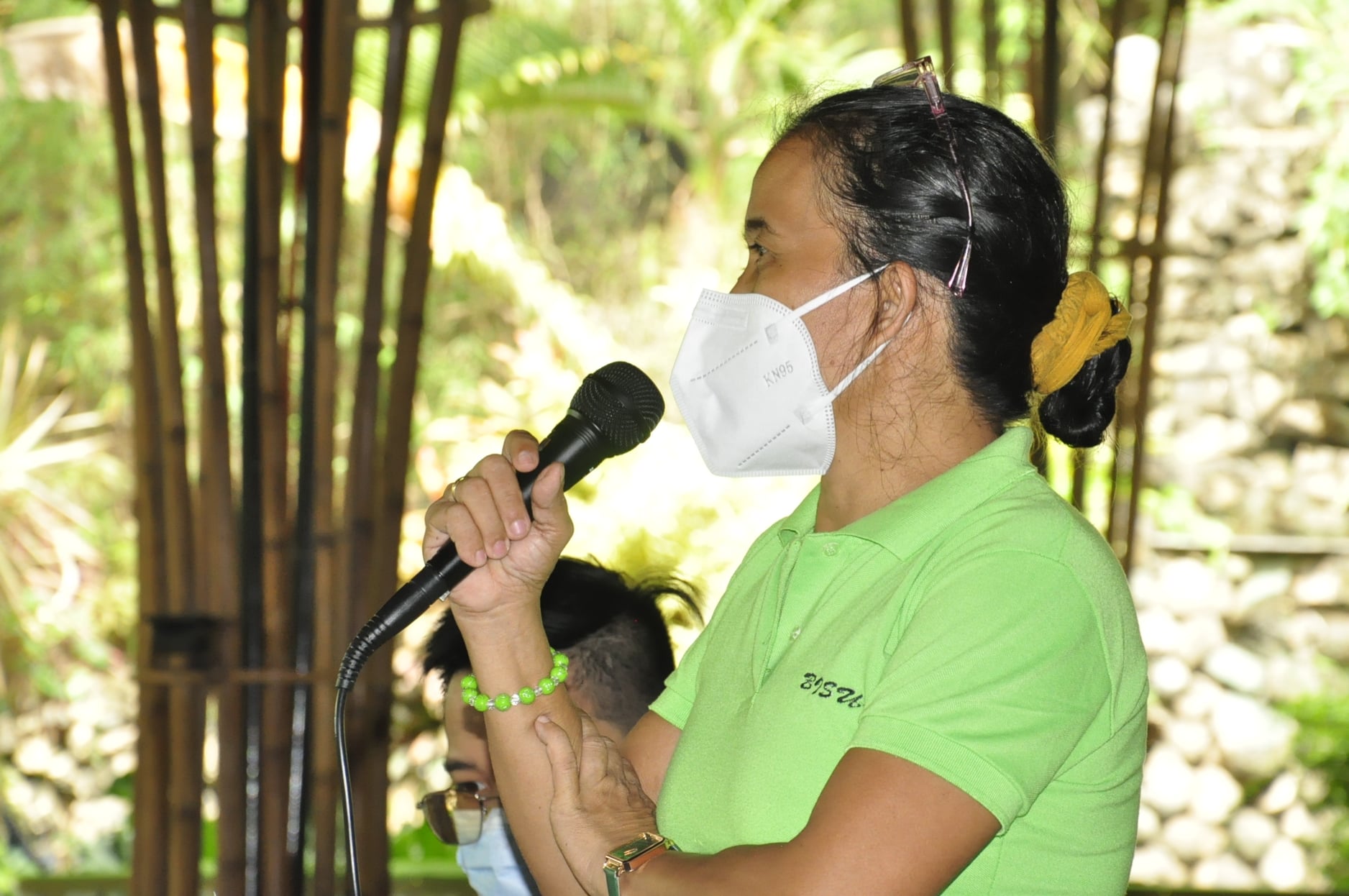
BISU PREPARES FOR F2F CLASSES. Bohol Island State University (BISU) Information Officer Prof. Bern Villarojo updates members of the Association of United Development Information Officers on the status of BISU’s preparations in reopening classes anytime soon. (RAHC/PIA7 Bohol)
Kids bound for Bohol exempted from RT-PCR tests

CORTES, Bohol, Nov. 26 (PIA) -- Bohol Gov. Arthur Yap has issued a new executive order relaxing the travel protocols for children bound for Bohol.

Children 11 years old and below who are traveling to Bohol with their fully vaccinated parents or guardians are now exempted from the Reverse Transcription Polymerase Chain Reaction (RT-PCR) coronavirus disease (COVID) swab test effective Nov. 27.

Yap, in consultation with mayors, issued Executive Order No 52-C.

The new E.O. also considered the drastic decrease in active COVID-19 cases in Bohol in the past two months and the establishment and operationalization of Temporary Treatment and Monitoring Facilities here.

The new order amended Executive Order No. 52 which lifted the negative COVID-19 test results by RT-PCR taken 72 prior to travel to Bohol of fully vaccinated individuals, and instead requiring them to present only the validated and authenticated vaccination certificates.

The governor then issued another executive order amending E.O. 52 with EO 52-A, which temporarily allowed returning travelers to enter Bohol using their duly signed and authenticated vaccination card, along with a government-issued identification card and S-pass, in the absence of a vaccination certificate, until Nov. 30.

For non-Boholanos, the generation of a vaccination certificate and an approved S-pass for fully vaccinated individuals forms as the travel requirement for entry, while a negative for COVID-19 swab test result through RT-PCR sticks as a travel entry requirement for non-vaccinated travelers to Bohol.

By Oct. 30, the governor issued Executive Order No. 52-B which temporarily allowed the use of vaccination cards in place of vaccination certificates, and streamlined the travel requirements for vaccinated individuals on their way to Bohol.

That same E.O. ruled that incoming fully vaccinated travelers must present their vaccination cards, a government-issued ID Card and an approved or pending S-pass application.

For those who are unvaccinated, the COVID-19 test result done 72 hours prior to travel as well as an approved S-pass shall be required in the ports of entry and as requirement for buying tickets.

Section 5 of the Executive Order also provided that children four years old and below are exempted from the RT-PCR negative test result.

On Nov. 27, this section is amended and expands the exemption from the presentation of a negative for COVID-19 test result via RT-PCR for four years old and below to 11 years old and below, as long as they travel with fully vaccinated parents or guardians.

The exemption from the RT-PCR requirement does not, however, apply if the minors are traveling with unvaccinated parents or guardians.

In such cases, the negative for COVID-19 test results as validated by RT-PCR would be required for the adults and the exemption can only work as long as the accompanying adult tests negative for the viral disease. (RAHC/PIA7 Bohol)